

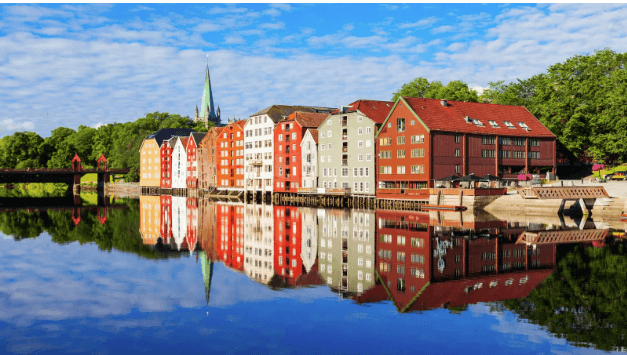
We are delighted to announce that Dr Simon Hickinbotham from the RIED team, supported by Prof Andy Tyrrell, presented a paper and poster at the 2025 IEEE Symposium Series on Computational Intelligence in Trondheim, Norway 17th-20th March 2025. This is the third time Simon and RIED have presented at this particular Symposia going back to 2022. The IEEE SSCI is widely recognized for cultivating the interchange of state-of-the-art theories and sophisticated algorithms within the broad realm of Computational Intelligence Applications. The Symposia provided for cross-pollination of research concepts, fostering an environment that facilitates future inter and intra collaborations. More information can be found via the following link.2025 IEEE SSCI – Trondheim, Norway.

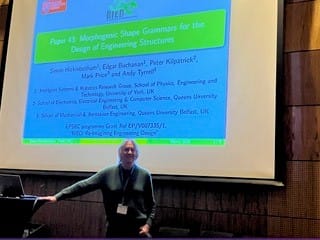
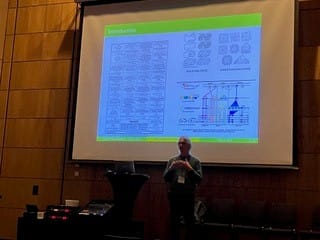
Simon’s paper was on “”Morphogenic Shape Grammars for the Design of Engineering Structures”. The paper and poster will be released on our RIED website as soon as they are available after the event, but for now here is the abstract.
Bodies of multicellular organisms are laid out according to morphogens: chemical agents which establish a coordinate system in the early embryo and use this to decide where body parts should grow. This process offers a mechanism for the automation of the design of engineering constructs via evolutionary search in a similar manner to the way biological evolution has driven the diversity of body forms of life on Earth. There are many ways of encoding such body plans, but the main existing approaches have problems around managing the complexity and stability of the evolutionary search process, particularly when applied to practical engineering design problems. This contribution takes the notion of morphogen chemical gradients and uses it to develop a novel grammar for shape formation. The central idea is to organise and label the spatial sub-regions of a design before making decisions regarding the finished arrangement of structure. This makes it much simpler to explore compositions of the hierarchy of sub-assemblies in a design, and to represent design of shape in an evolvable manner. A worked example of such a morphogenic shape grammar is described, and used in a multi-objective evolutionary search for optimal bridge truss structures over four fitness objectives with two design constraints. The resulting Pareto front shows a wide variety of bridge designs, demonstrating the power of this approach to generate a diverse set of viable options to meet engineering design challenges.